Vietnamese agarwood seeks opportunities in UAE through CEPA bridge
VAWA - Attending the UAE - Vietnam Comprehensive Economic Partnership Agreement Promotion Conference, the delegation of the Vietnam Agarwood Association has more opportunities to connect with a market rich in the tradition of using fragrances, where agarwood essential oil can become a trade and cultural bridge.
VOV.VN -
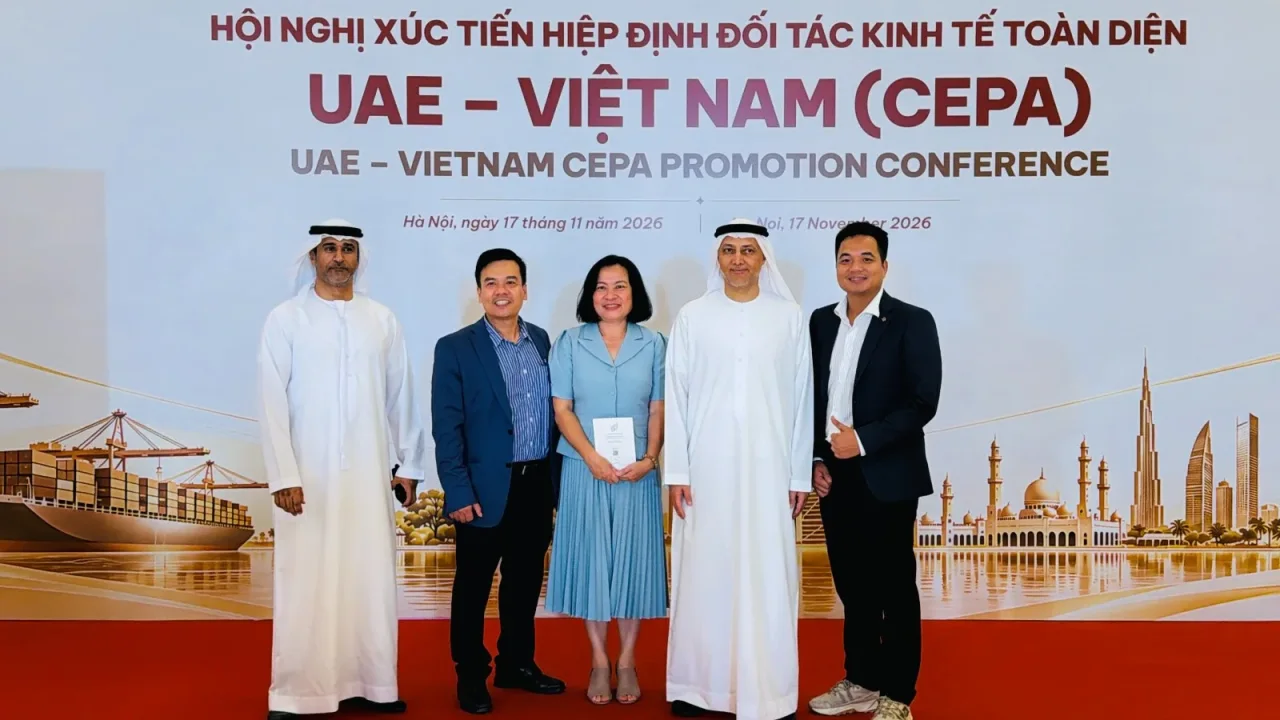
On November 17, in Hanoi, a delegation from the Vietnam Agarwood Association attended the UAE - Vietnam Comprehensive Economic Partnership Agreement (CEPA) Promotion Conference. Mr. Nguyen Van Tung, Chief of Office of the Association, represented the delegation at the event.
The conference was organized by the Embassy of the United Arab Emirates (UAE) in Hanoi in coordination with the Ministry of Industry and Trade at the Almaz Convention Center. According to the announced program, the event focused on presenting opportunities from CEPA, sharing experiences in leveraging the agreement, and directly connecting businesses from both countries.
According to information from the Vietnam Agarwood Association delegation, during discussions at the event, the UAE Embassy representative highly praised agarwood and expressed an affinity for agarwood essential oil. This interest suggests a concrete direction for connecting Vietnam's agarwood industry with a market that has a long tradition of using fragrances in daily life.
From raw material regions in Vietnam to fragrance shops in Dubai, this is a commercial journey with many requirements. However, a common meeting point has already been established: one side possesses the capability to produce raw materials and products, while the other holds a culture of fragrance appreciation and an international trade network.
Two economies, complementary advantages
The Vietnam – UAE CEPA was signed on October 28, 2024, and took effect on February 3, 2026. This serves as a foundation for businesses of both countries to expand cooperation, leveraging two-way gateway advantages: accessing the Middle East, Africa, and the Gulf region from the UAE; and connecting to the ASEAN market from Vietnam.
According to the Ministry of Industry and Trade, the UAE has committed to a roadmap for tariff elimination on 99% of Vietnam's export turnover to the UAE; Vietnam has made a corresponding commitment on 98.5% of the UAE's export turnover to Vietnam. These commitments create room to enhance the competitiveness of goods while promoting access to capital, technology, and services.
Vietnam has a diversified production base, ranging from agricultural and forestry products to processing and manufacturing industries. According to the General Statistics Office, in 2025, the GDP scale at current prices is estimated at USD 514 billion, with economic growth reaching 8.02%. Industry and construction account for 37.65% of the economic structure; services account for 42.75%. This is the foundation for Vietnam to expand exports and elevate the level of product processing.
Meanwhile, the UAE has strongly developed non-oil activities. According to the Federal Competitiveness and Statistics Centre of the UAE, non-oil GDP in 2025 grew by 6.8%; trade, finance – insurance, construction, and manufacturing are major contributing sectors in this area. Alongside its role as an international trade and investment hub, this economic structure enables the UAE to connect goods with numerous markets.
Bilateral trade relations already have a substantial foundation. According to customs data compiled by the Ministry of Industry and Trade, the two-way turnover in 2025 reached approximately USD 6.55 billion, with Vietnam exporting over USD 5.9 billion. For the agarwood industry, the opportunity lies in securing a position within this trade network through quality products with distinct identities.
Agarwood essential oil: From raw material to brand value
In Dubai, oud and bakhoor are introduced as traditional Arabian fragrances. Perfume culture is also part of the heritage showcased at the Al Shindagha Museum. This demonstrates that agarwood approaches the UAE market on the foundation of an existing cultural demand.
Agarwood essential oil is extracted from agarwood materials through a distillation process and can be used as an ingredient for high-value perfumes. Compared to selling raw materials, developing essential oil opens up the potential to participate deeply in the fragrance industry.
A study published in the journal Processes in 2019 surveyed agarwood samples from aquilaria trees cultivated in Bac Giang, Khanh Hoa, and Phu Quoc, according to locations at the time of the study. The distillation results yielded an essential oil recovery rate ranging from 0.25% to 0.32% by weight; analysis identified 44 volatile compounds. The authors evaluated that the composition of these essential oil samples demonstrates the commercial viability of using them as valuable aromatic raw materials. These are results based on specific research samples, not a general recovery rate for all types of agarwood.
Such data suggests a direction for development: the value of essential oil must be proven through quality profiles, composition, and consistency across batches. For professional clients, the narrative surrounding the origin of Vietnamese agarwood becomes more convincing when accompanied by verifiable capabilities.
Therefore, to turn the interest shown at the conference into commercial cooperation, businesses need to simultaneously prepare product samples, raw material source information, supply capacity, and quality control plans. Alongside selling essential oil to perfume manufacturing partners, finished product lines suited to local tastes can be researched.
CEPA preferential treatments must also be checked against product codes, rules of origin, and the specific roadmap of each item. For agarwood, businesses must additionally determine CITES obligations corresponding to the species, product form, and transaction case; trade preferences cannot be viewed as a substitute for legal origin requirements.
The presence of the Vietnam Agarwood Association at the conference places this industry into a broader cooperative space. The Association can act as a bridge to gather businesses, standardize product information, and connect with importers and fragrance manufacturers.
An expression of fondness for agarwood essential oil is a noteworthy beginning. To move toward sustainable orders, Vietnamese agarwood needs to conquer partners with verifiable quality and reliable supply capabilities. Only then will each exported product have the opportunity to carry both commercial value and the reputation of Vietnamese agarwood.
Editorial note: As the exact name and title of the UAE representative were not provided, the article uses "UAE Embassy representative" and reports indirectly, without turning the sentence "I love agarwood essential oil" into a direct quotation.