
“Awakening” the agarwood formation mechanism of the Aquilaria tree: A biological approach opening new efficiency for the agarwood industry
VAWA - For many years, artificial agarwood formation on Aquilaria trees (Aquilaria spp.) has remained a difficult challenge for foresters and agarwood production enterprises
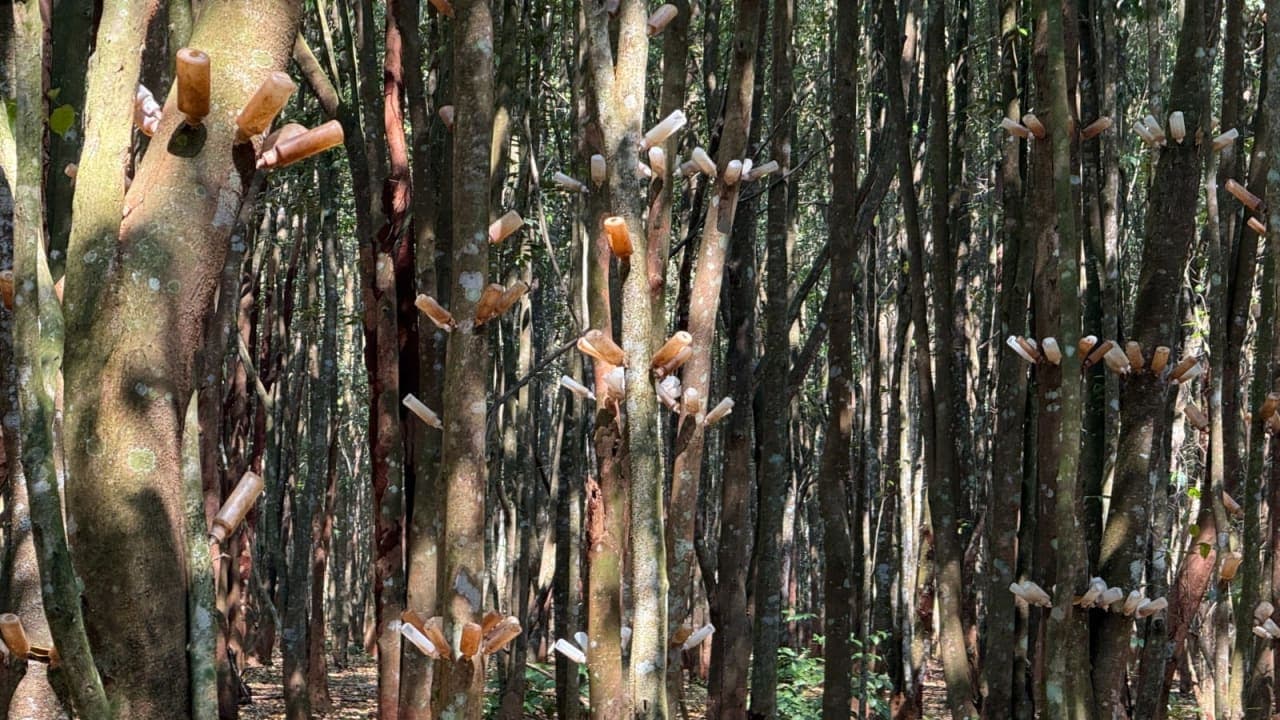
For many years, artificial agarwood formation on Aquilaria trees (Aquilaria spp.) has remained a difficult challenge for foresters and agarwood production enterprises. Many mechanical or chemical intervention models have yielded low results, thin agarwood, and unstable quality. A new approach – based on “activating the recognition response” of the tree – is opening expectations to enhance performance and economic value for this specialized industry.
Recognition response – the biological “switch” of the agarwood formation process
According to studies in the field of Plant Physiology, when an Aquilaria tree is injured, it activates two levels of response:
Physical response: formation of callus tissue, structural regeneration to seal the wound. This is a common “healing” mechanism.
Biochemical response: production of secondary compounds such as Sesquiterpenes and Chromones – the core components that create agarwood.
The key point lies in the recognition threshold of plant cells. If the stimulus (drilling, chemicals, microbes…) is not strong enough or lacks the correct “signal”, the tree only considers it a common mechanical injury. At that point, metabolism does not shift toward defense, leading to:
Low rate of trees forming agarwood
Thin agarwood layers, scattered distribution
Low essential oil and active ingredient content
In production reality, there are models impacting 100 Aquilaria trees but only about 20–30% of trees form agarwood, and the volume of agarwood obtained only accounts for less than 1% of the wood weight – an efficiency level not commensurate with investment costs.
“Sending false signals” – a new direction in agarwood formation techniques
Experts believe that to improve efficiency, it is necessary to intervene in the tree's own “recognition machinery”. This approach can be simply understood as:
Creating a “false signal” strong and accurate enough to deceive the defense system, making the tree believe it is under serious biological invasion.
Then, the tree will mobilize maximum biochemical resources, strongly activating the agarwood formation process, instead of just reacting at a healing level.
Some advanced biological solutions – typically Bioyersin technology – are being researched in this direction, using a combination of biological signals to activate the tree's deep defense response, rather than just causing simple mechanical injury.
Directing the biochemical flow – the decisive factor for agarwood quality
After the recognition response is activated, the next issue is “direction” – meaning controlling the flow of energy and materials inside the tree.
Under natural conditions, this process occurs randomly:
Agarwood is unevenly distributed
Quality varies by region
Difficult to control yield
Conversely, with scientific intervention, growers can:
Concentrate the agarwood formation area in desired locations
Increase the density of aromatic compounds
Shorten the agarwood accumulation time
Initial trials show that if both “recognition” and “direction” factors are well controlled, the rate of trees forming agarwood can increase to 60–80%, with the volume of agarwood reaching 2–5% of the wood weight – a significant step forward compared to traditional methods.
Prospects for the Vietnam agarwood industry
Vietnam is evaluated as one of the countries with great potential for agarwood, with Aquilaria cultivation areas stretching from the Central region to the Central Highlands and the Southeast. However, the major problem remains low efficiency and inconsistent quality.
The application of modern biological solutions:
Reduces dependence on traditional drilling methods
Increases economic value per tree
Aims for sustainable agarwood production
In the context of increasing international market demand, especially from the Middle East and East Asia, technologies like Bioyersin, if verified and scaled up, could become a “lever” helping the Vietnam agarwood industry elevate its position on the world map.
The story of agarwood formation is no longer simply “causing injury to extract resin”, but is shifting toward controlled biological regulation. Understanding and correctly intervening in the “recognition response” is the key to opening a new door – where efficiency, quality, and sustainability can go hand in hand.
Author: Bioyersin Agarwood